
The Parallel: Soul vs. Spec Sheets
I recently moved the family to Spain, and in the process, I liquidated most of my camera gear. I told myself I’d be happy with the smartphone in my pocket, but after a few months of shooting the boys in the Mediterranean light, I realized the images felt sterile. They were too perfect, too computed. I found myself missing the unpredictability of film—the way a certain stock renders a sunset not as a collection of high-dynamic-range data points, but as a mood.
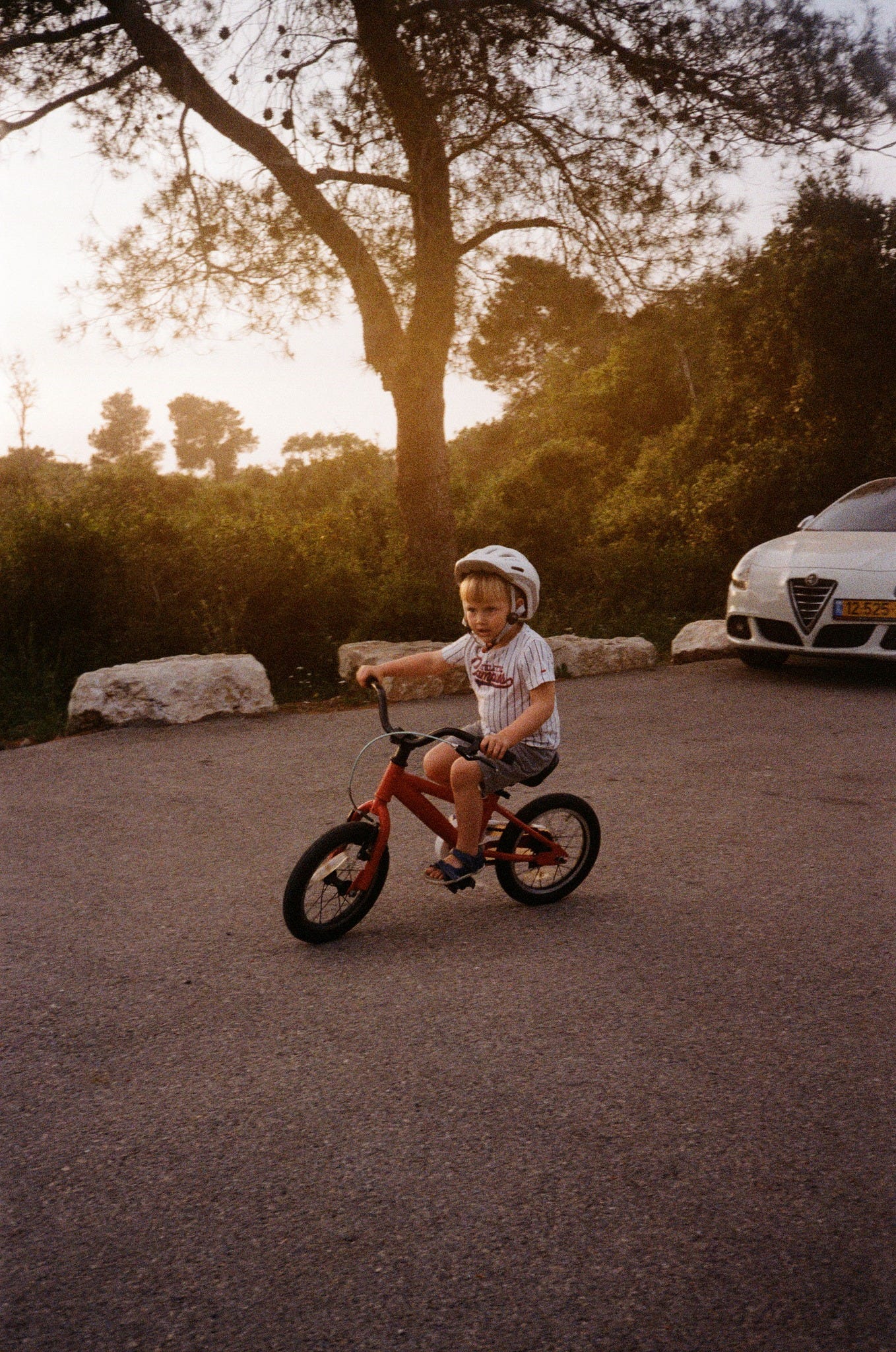
A 35mm film photograph
However, I didn’t want to deal with the rising cost of rolls or the lead times of lab processing while trying to settle into a new country. I started wondering if I could find a shortcut to that aesthetic by looking backward rather than forward.
The Setup: The S45 System
I decided to test a theory I’d seen floating around certain corners of the web: that early digital sensors possess a “soul” that modern ones have scrubbed away in the name of efficiency. I spent €45 on a Canon PowerShot S45, a brick-like device from 2002. It doesn’t have a modern CMOS sensor; instead, it uses a CCD, a type of light-gathering hardware that reads the entire sensor at once and, arguably, renders color with a more organic, film-like saturation.
Plaintext
System: Canon PowerShot S45 (Circa 2002)
Sensor: 1/1.8" CCD (4.0 Megapixels)
Processor: DIGIC 1
Storage: CompactFlash (CF)
Interface: Tactical sliding lens cover, manual control dial
Holding the S45 feels like holding a piece of industrial equipment. It has weight, it makes mechanical noises, and it forces a specific cadence. You cannot “spray and pray” with this device. It demands that you wait for the buffer to clear.
The Friction: The ISO Wall
The experiment hit reality the moment the sun began to dip behind the hills. Modern sensors have spoiled us; we expect to shoot in near-darkness and let software sort out the mess. The DIGIC 1 processor inside the S45 has no such intelligence. I quickly discovered what I call the ISO Wall.
While the camera claims to go higher, anything above ISO 100 introduces a level of electronic noise that doesn’t look like pleasant film grain—it looks like a broken television. The sensor “fatigues” almost immediately when the light isn’t optimal. This constraint changed my behavior. I stopped trying to capture everything and started looking for the light first, and the subject second. If the light wasn’t there, the camera stayed in my pocket. It is a fragile system that requires a high-light environment to maintain its integrity.
The Signal and Load
There is a significant difference in the cognitive load between shooting with an iPhone and the S45. With the phone, the signal is “everything is a photo.” The computational overhead is handled by the device, leaving me with a flat, predictable result. With the S45, the signal-to-noise ratio is much tighter. I have to think about the exposure compensation and the white balance because the early internal logic often gets it wrong.
The friction of using old tech is actually a filter; it forces you to decide if a moment is actually worth the effort of capturing.
Surprisingly, when I run the files through my PIXMA G650 printer at 13x18 size, the 4-megapixel files hold up beautifully. The “imperfections”—the slight softness and the specific way the CCD handles the blues and reds—provide a look that I would usually spend twenty minutes trying to emulate in post-processing software.

A CCD-sensor shot from the S45
What Stood the Test
The experiment confirmed that I don’t need to chase a $700 Fujifilm X100 to feel inspired. The “Third Way” of photography is now my ground truth. It’s a space that sits between the mindless convenience of a smartphone and the high-maintenance ritual of film.
The S45 proved that character matters more than cost. The hardware is slow, the screen is tiny, and the battery life is questionable, but the output has an aesthetic “thickness” that modern gear lacks. It isn’t a 1:1 replacement for 35mm film, but it satisfies the same creative itch for a fraction of the price.
Final Reflections
I am merging the “vintage digital” approach into my permanent toolkit. The S45 will stay in my bag for those bright, coastal afternoons where I want the world to look a bit more like a memory and less like a data set. I’m backlogging the idea of buying a high-end mirrorless body for now; the “Side Quest” taught me that I was bored with the sensor, not the hobby.